
 CEMUS Library/Lab/Lounge at Villavägen 16, campus Geocentrum, is a multifunctional space and meeting place for students, staff and organisations, where you can study, find course literature, work on projects or just relax. You can book it for events in line with CEMUS and Uppsala University’s activities and issues (see details below). The events can be open to the public, by invitation or a closed meeting. The space can be used free of charge. Contact Daniel Mossberg, Lead Outreach Coordinator, with your questions at daniel.mossberg@cemus.uu.se or phone 073-065 02 28.
Please respect the following general guidelines and terms of use:
- In CEMUS and Uppsala University’s spaces you’re not allowed to lights candles or other flammables.
- Feel free to fika and eat as you like.
- Feel free to move furniture around and rearrange the space, but don’t block the central corridor part since it’s a fire escape, evacuation corridor.
- Respect other peoples use of the space. When the space is booked and used for a seminar, meeting, workshop, minimize the amount of disturbing noices. If you want to use the space without other people using the space, state so when booking in the calendar.
- Selling or marketing of services or products to students or staff as private citizens isn’t allowed (unless you have a contract with Uppsala University where it’s allowed).
- Leave the space in a nicer state than what you found it in – cleaning equipment is available in a cabinet in the main corridor.
For details see Uppsala University’s rules and regulations document: Riktlinjer för tillträde och upplåtelse till Uppsala universitets lokaler.
All bookings are made in a paper calendar in CEMUS Library, if it’s the first time making a booking please send an email to Daniel Mossberg briefly describing your organization and what you want to use the space for.
Practicalities
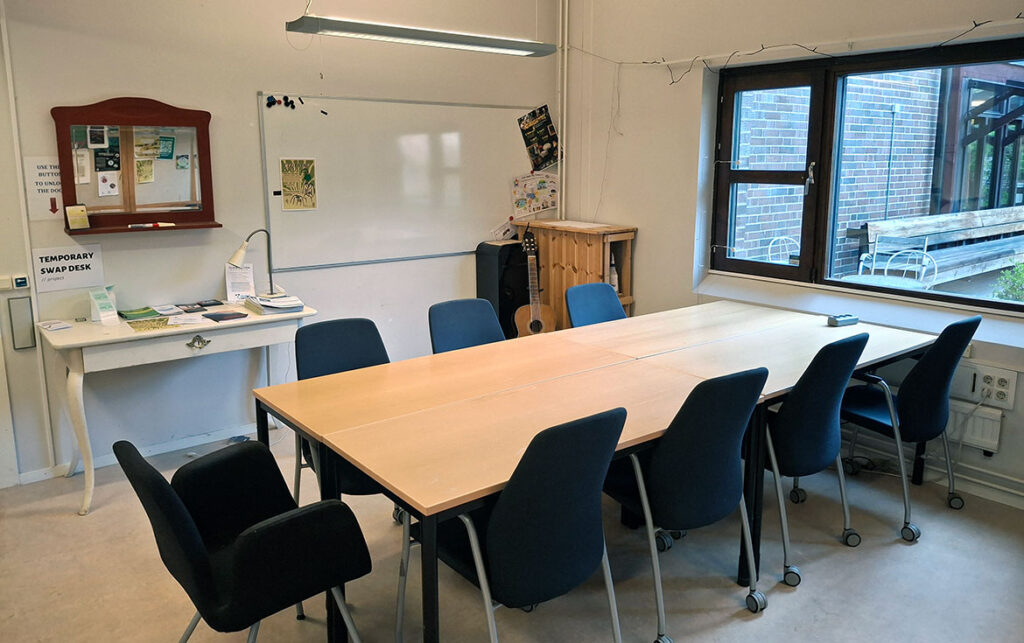
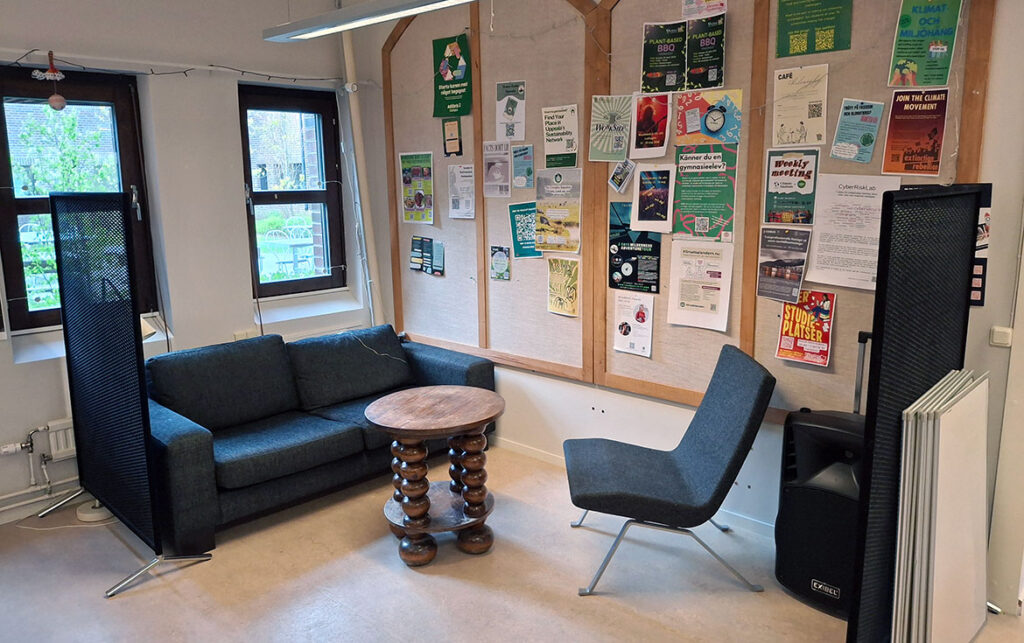
One side of the space has a smaller lounge area with a sofa and armchairs, which seats around 4-5 people, and four tables joined with chairs that seats 9 people depending on arrangements.
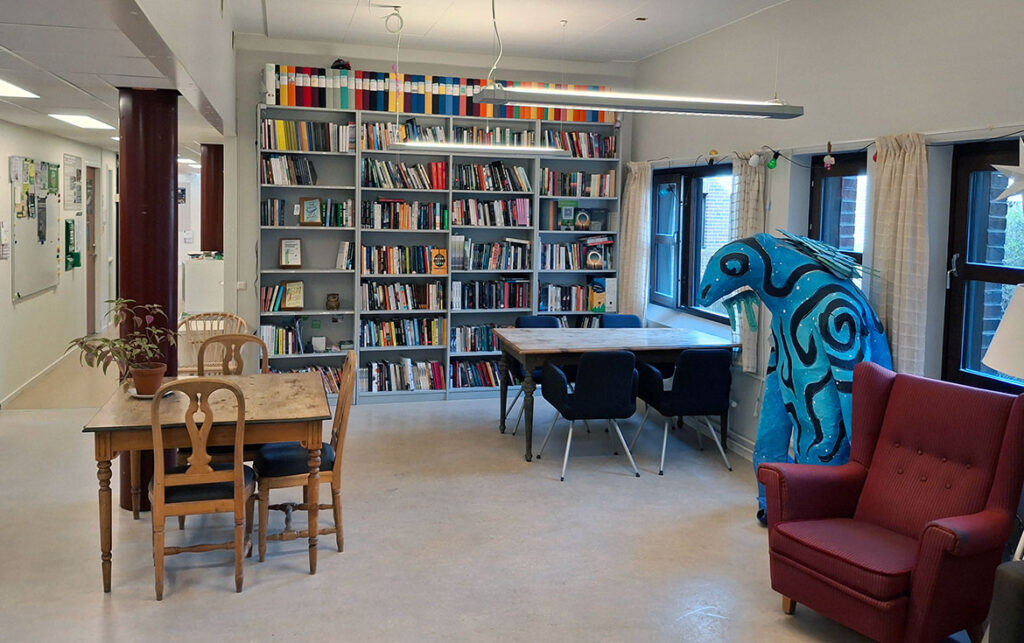
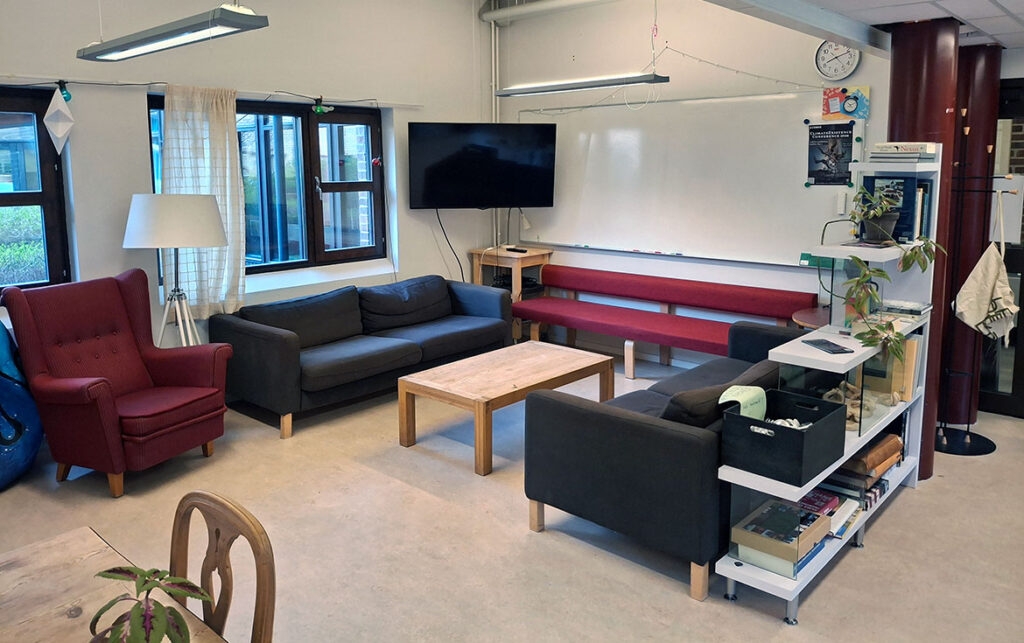
The other side has two tables with chairs that seats up to 4-5 people each, and a sofa meeting, lounge area with TV for 9-10 people, depending on how they are organized.
There’s a TV-screen for presentations or screenings, wall-mounted and portable whiteboards. If want a projector for bigger presentations you need to brings this and a projector screen yourself, the same goes for workshop material. On both sides of CEMUS Library there are two courtyards you also can use.
In the long corridor running through Geocentrum there’s a student kitchen that you can use, see map below.
place for books, late 14c., from Anglo-French librarie, Old French librairie, librarie “collection of books; bookseller’s shop” (14c.), from Latin librarium “book-case, chest for books,” and libraria “a bookseller’s shop,” in Medieval Latin “a library,” noun uses of the neuter and fem., respectively, of librarius “concerning books,” from Latin librarium “chest for books,” from liber (genitive libri) “book, paper, parchment.”Latin liber (from Proto-Italic *lufro-) was originally “the inner bark of trees,” and perhaps is from PIE *lubh-ro- “leaf, rind,” a derivative of the PIE root *leub(h)- “to strip, to peel” (see leaf (n.)). Comparing Albanian labë “rind, cork;” Lithuanian luobas “bast,” Latvian luobas “peel,” Russian lub “bast,” de Vaan writes that, “for want of a better alternative, we may surmise that liber is cognate with *lubh- and goes back to a PIE word or a European word ‘leaf, rind.'”
The equivalent word in most Romance languages survives only in the sense “bookseller’s shop” (French libraire, Italian libraria). Old English had bochord, literally “book hoard.” As an adjective, Blount (1656) has librarious.
shortened form of laboratory, 1895. Laboratory (n.) c. 1600, “room or building set apart for scientific experiments,” from Medieval Latin laboratorium “a place for labor or work,” from Latin laboratus, past participle of laborare “to work” (see labor (v.)). Figurative use by 1660s.
1806 as “act of lounging;” 1830 as “couch on which one can lie at full length;” 1881 as “comfortable drawing room” (suitable for lounging); from lounge (v.). Earlier senses, now out of use, were “pastime” (1788), “place for gathering” (1775). Lounge lizard is by 1917, perhaps 1912, originally in reference to men who loitered in tea rooms to flirt.