
Join us for a creative, fun and hands-on two-day upcycling workshop in the Botanical Garden with Sonali Phadke, Stephanie Foote and Daniel Mossberg!
When: May 19-20 at 10.00-15.00 (with modules running 10.00-12.00, 13.00-15.00 both days)
Where: The Water Lily Pond (Näckrosdammen), The Botanical Garden Uppsala, see map here: https://link.mazemap.com/uufaznsf
Cost (including materials and coffee/tea): Two-day workhop: 499 SEK or one two-hour module: 149 SEK.
Registration: https://doit.medfarm.uu.se/bin/kurt3/kurt/8901959
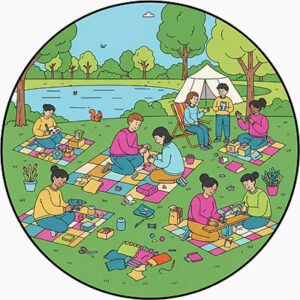
How: Take part in an open two-day workhop or one the modules. Materials and coffee, tea included. Bring your own lunch, snacks and blanket or lawn chair. We’ll be building new, functional and beautiful items out of scrap and discarded materials lead by Sonali Phadke from studio Alternatives in India.
Workshop Facilitators
Please contact Daniel Mossberg, daniel.mossberg@cemus.uu.se, with your questions.
 Sonali Phadke Partner and Creative connections studio Alternatives
Sonali comes with an engineering background and her family business in composites and plastics triggered her initial interest in reusing waste. Also, an alumni of The Ecological Society Pune has been a resource person for many environment/socio-economic projects and surveys. She has been an active member of Oikos for Ecological Services and was a part of the Maharashtra Environment Department-funded project on Eco-Education. She is also a team member of the Grassland Trust that works in grassland conservation from both the aspects of human and wildlife concerns. With her background, Sonali brings in the aspect of sustainability from the ecological perspective in the studio’s work.
 Daniel Mossberg Lead Outreach and Educational Coordinator CEMUS, Uppsala University
Daniel works as lead outreach coordinator and educational coordinator at CEMUS with a wide range of first-hand experience of student-led education, developing new, interdisciplinary courses and programs, open events in collaboration with different partners, creative projects with focus on local sustainability, critical conversations on current and existential issues, open online courses on climate change leadership and much more. He has worked as course coordinator, director of studies, deputy director, with an academic background in cultural anthropology, philosophy, American studies, environment and development studies and climate and sustainability studies. Engaged as student, staff and union representative over the years, and now safety representative at CEMUS.
daniel.mossberg@cemus.uu.se
073-065 02 28
Stephanie Foote is Professor of English. She researches and teaches American literature and culture from the nineteenth century to the present with a particular focus on environmental issues. She is the author of two single-author books The Parvenu’s Plot: Gender, Class, and Culture in The Age of Realism (2014) and Regional Fictions: Culture and Identity in Nineteenth-Century American Literature (2001). In 2006, she edited and contributed original afterwords for We Walk Alone and We, Too, Must Love, Ann Aldrich’s 1955 and 1958 sociological accounts of lesbian life in the US. She co-edited (with Elizabeth Mazzolini) Histories of the Dustheap: Waste, Material Cultures, Social Justice (2012), and in 2022 she and Jeffrey Jerome Cohen edited The Cambridge Companion to the Environmental Humanities. With Stephanie LeMenager, she co-founded Resilience: A Journal of the Environmental Humanities, which is available on ProjectMuse and JSTOR; she co-edited that journal for over a decade. With Dana Luciano and Anthony Lioi, she is the co-founder and co-editor of the open-access journal Regeneration: Environment, Art, Culture. She is currently working on a book about garbage and waste. She has published more than 20 articles and book chapters in journals such as PMLA, Signs, American Literary History, and American Literature, and her work has been funded by the Carnegie Foundation, the Mellon Foundation, the National Endowment for the Humanities, and the National Humanities Center.