Part 1 | Part 2 | Part 3 | Part 4 | Part 5
3.14
The Swedish Plastic Bottle Recycling System: Returpack – Pantamera
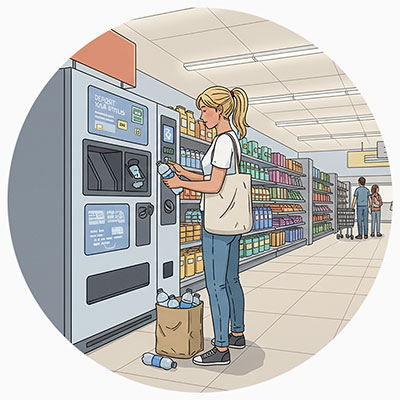
Now it’s time to investigate recycling of plastics, which was partially covered in the previous steps since a lot of textiles are made out of polyester. Here we’ll introduce the recycling of plastics, why the process is complicated and the Swedish plastic bottle collection and recycling program.
The study ‘Complexities of the global plastics supply chain revealed in a trade-linked material flow analysis’ details the global plastics sector in 2022. Of the 400 million tonnes of plastic produced, only 9.5 percent utilized recycled material, with the remaining 90.5 percent derived from fossil fuels. The analysis found the global plastic recycling rate remained stagnant at approximately 9 percent. Waste management dramatically shifted, with landfilling at 40 percent and incineration emerging at 34 percent. This complex, trade-linked supply chain and persistent reliance on virgin materials pose a pressing environmental challenge, hindering global sustainability efforts.
Two graphs in the article is worth looking closer at, ‘Fig. 1: Global plastic cycles in 2022’ here, and ‘Fig. 4: Global plastics waste generated’ here.
In the video below you get a summary of why recycling of plastics is so confusing and complex, how recycling could be made easier, and producers taking on greater responsibility.
In the video here you get a summary of what plastics are used for today, its history and the problem of plastic waste.
The Swedish Plastic Bottle Recycling System
Sweden has developed a recycling model driven by producer responsibility and a ban on landfilling household waste since the early 2000s. In 2023, approximately 39 percent of municipal waste was recycled, with 59 percent used for energy recovery (primarily incineration). An important part of this system is the Pantamera deposit scheme, which collects nearly 3 billion beverage cans and PET plastic bottles annually, achieving high return rates, nearing the 90 percent return goal. This short video summarizes how the system works.
The Pantamera ads, like the Hooja music video ‘Pantamaskineriet’ below, use humor and cultural trends to motivate recycling. This strategy, focusing on positive reinforcement and cultural resonance, effectively encourages the public, especially younger audiences, to return their cans and bottles.
Further reading, learning and references
Laville, S. (2025). Just 9.5% of plastic made in 2022 used recycled material, study shows. The Guardian https://www.theguardian.com/environment/2025/apr/10/just-95-of-plastic-made-in-2022-used-recycled-material-study-shows
Hemingway Jaynes, C. (2025). Global Plastic Recycling Rate ‘Stagnant’ at 9%: Study. EcoWatch https://www.ecowatch.com/global-plastic-recycling-rate.html
Houssini, K., Li, J. & Tan, Q. (2025). Complexities of the global plastics supply chain revealed in a trade-linked material flow analysis. Communications in Earth & Environment 6, 257 https://doi.org/10.1038/s43247-025-02169-5
Returpack – Pantamera https://www.pantamera.nu/
Sweden is aiming for zero waste, through laws and encouragement. This is how https://sweden.se/climate/sustainability/swedish-recycling-and-beyond
© Daniel Mossberg, CEMUS, Uppsala University and Sonali Phadke, studio Alternatives and Stephanie Foote