
Part 1 | Part 2 | Part 3 | Part 4 | Part 5
1.6

Intro to the Circular Economy: Concept and Principles
This step introduces the Circular Economy as a systemic model to replace the linear “take-make-dispose” approach, focusing on two cycles (biological and technical). It details the three core Circular Economy principles — eliminate, circulate, and regenerate — and the Potting et al. R-framework for ranking circularity strategies.
Introducing the concept of the Circular Economy
The Re-thinking progress video advocates for a circular economy to replace the unsustainable “take-make-dispose” approach. This model uses a biological cycle for safe, compostable materials and a technical cycle for reusing and regenerating durable goods. By designing products to return to their makers and using renewable energy, this systemic rethink aims to build long-term prosperity.
The butterfly diagram illustrates the circular economy’s dual-flow system. The technical cycle keeps products in use through reuse, repair, and recycling, while the biological cycle safely returns nutrients from biodegradable materials to the Earth, regenerating nature.
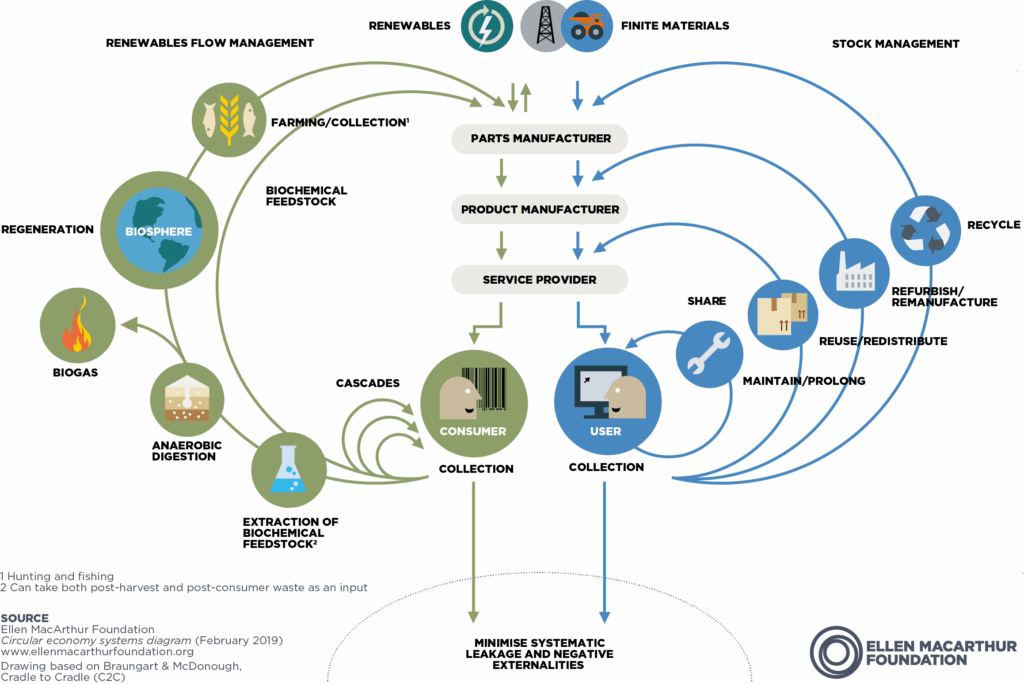
Read more about the Butterfly Diagram and watch intro video at the Ellen MacArthur Foundation web page here.
Circular Economy principles
The circular economy is based on three principles: eliminate waste and pollution by designing products for circularity from the start; circulate products and materials through maintenance, reuse, remanufacturing, or recycling; and regenerate nature by using restorative practices like farming that builds biodiversity. This regenerative model aims to mimic natural systems where there is no waste. More on these principles from the Ellen MacArthur Foundation here.
Morseletto writes in the article “Targets for a circular economy” about another framework, set of principles. The Potting et al. framework ranks circular economy strategies from R9 (highest circularity) to R0 (lowest). This hierarchy is a useful ‘rule of thumb’ for orientation, but it isn’t perfect. Exceptions and rebound effects mean the R-order should be taken with caution and isn’t strictly applicable to all products.

Circular Economy strategies, from Potting et al. (2017) – colours modified by Morseletto (2020).
Further reading, learning and references
The Ellen MacArthur Foundation www.ellenmacarthurfoundation.org/
Morseletto, P. (2020). Targets for a circular economy. Resources, Conservation and Recycling, 153(1), p.104553. https://doi.org/10.1016/j.resconrec.2019.104553
Potting, J., Hekkert, M., Worrell, E. and Hanemaaijer, A. (2017). CIRCULAR ECONOMY: MEASURING INNOVATION IN THE PRODUCT CHAIN Policy Report. [online] Available at: https://www.pbl.nl/uploads/default/downloads/pbl-2016-circular-economy-measuring-innovation-in-product-chains-2544.pdf
The Circularity Gap Report 2025 https://global.circularity-gap.world/report.pdf
© Daniel Mossberg, CEMUS, Uppsala University and Sonali Phadke, studio Alternatives and Stephanie Foote