
Part 1 | Part 2 | Part 3 | Part 4 | Part 5
1.8
Your Weekly Consumption and Waste Tracker
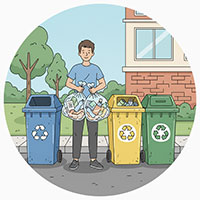
This assignment aims to create new understandings of the connection between consumption and waste on an individual level. You will be tracking all weekly purchases, noting the item, source, reason, and resulting waste. The goal is to get an overview and reflect on personal consumption patterns, the lifecycle of purchases, and the associated carbon cost.
This week’s assignments focuses on your consumption and the waste accumulated over a week, in the current linear economic system. In this assignment, you will keep a list of everything you purchase in one week, why you purchased it, where you purchased it from, and what part of the purchase will immediately or eventually become waste. If you live in a household with more people than yourselves, just include the purchases and waste you have direct contact with, it doesn’t have to be a complete overview.
For example, you might list something like this:
- Laundry detergent, purchased from grocery store 1 kilometer from my house, replaces detergent that is almost used up. Contents of bottle will disappear into the wash, the plastic bottle itself can be recycled.
- T-shirt, purchased online and delivered to house by PostNord, purchased because I saw it and liked it. Packaging is cardboard and plastic, which I recycled. The shirt itself will last for over five years. I will probably turn it into rags when it is too beat up to wear.
As you keep your list, keep a neutral tone. It can feel easy to judge yourself when you keep the list, but the assignment is not meant to produce guilt or shame. Rather the assignment is simply a way to think about how and why we consume, and to begin to think about the environmental, social and carbon cost of our purchases. While this assignment is not about calculating your carbon footprint, it can help think about a small part of that footprint. If you are interested in calculating the carbon footprint of one week’s worth of your purchases, there are many carbon calculators online, such as this one here.
After a week, depending on when you started this assignment, you can share your insights, thoughts and feeling here on the course Studium page or in the Whatsapp group.
Further reading, learning and references
Rebecca Solnit (2021). Big oil coined ‘carbon footprints’ to blame us for their greed. Keep them on the hook. The Guardian. https://www.theguardian.com/commentisfree/2021/aug/23/big-oil-coined-carbon-footprints-to-blame-us-for-their-greed-keep-them-on-the-hook
© Daniel Mossberg, CEMUS, Uppsala University and Sonali Phadke, studio Alternatives and Stephanie Foote