Part 1 | Part 2 | Part 3 | Part 4 | Part 5
1.10
EU’s Circular Economy Action Plan and Act

There are two key European Union initiatives on circularity, as part of the European Green Deal: the Circular Economy Action Plan (adopted in 2020) and the upcoming Circular Economy Act (set for adoption in 2026).
The European Commission highlights two key initiatives around circularity within the European Union, EU.
The Circular Economy Action Plan (2020) is a key component of the European Green Deal, focusing on sustainable growth. It contains both legislative and non-legislative measures addressing the entire product life cycle, from design to waste prevention, ensuring resources remain in the EU economy longer.
Building on the 2020 plan, the Circular Economy Act (due 2026) aims to create a single market for secondary raw materials. Its goal is to double Europe’s circularity rate from 12% to 24% by 2030, reinforcing the ambition to make the EU a global circular economy leader.
You can read more here, and get into the details of the whole action plan here. In the video below you get a critical summary of EU’s Green Deal.
A holistic approach is needed for implementing the Circular Economy
Florin-Constantin Mihai and Simona-Roxana Ulman (2023) argues that for Green Deal policies and strategies to be effective and create real change a holistic approach is needed, especially when it comes to the Circular Economy (CE). They write: “The future of the CE in Europe remains rather speculative at this point of time […] only a few countries from the EU have started the implementation of a complementary and meaningful CE strategy at the national level.” A holistic approach means a system-wide implementation of policies on different levels, with different stakeholders, and also integrating international trade and production beyond the European Union.
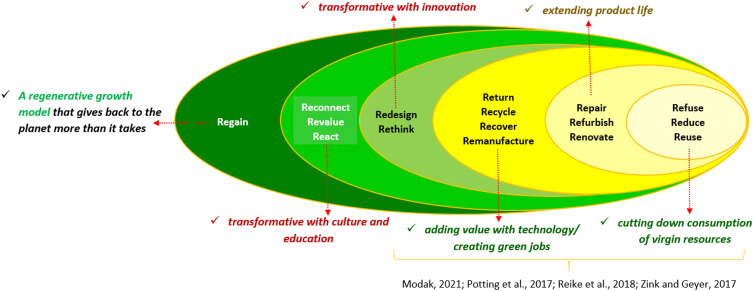
Mihau and Ulman (2023) build on Potting et. al. (2017), which we looked at during week 1, and other researchers in proposing four new Rs: “”reconnect,” “revalue,” “react,” and “regain,” as pointing out the type of transformation generated through culture and education, seen as highly important across the literature in this process of changing our world into one more oriented to human and environmental well-being”. The model with four added Rs then looks like this.
Further reading, learning and references
European parliament – Circular economy: definition, importance and benefits https://www.europarl.europa.eu/topics/en/article/20151201STO05603/circular-economy-definition-importance-and-benefits
European Commission – Circular Economy https://environment.ec.europa.eu/strategy/circular-economy_en
EU: A new Circular Economy Action Plan For a cleaner and more competitive Europe https://eur-lex.europa.eu/legal-content/EN/TXT/?qid=1583933814386&uri=COM:2020:98:FIN
EU: The European Green Deal https://commission.europa.eu/strategy-and-policy/priorities-2019-2024/european-green-deal_en
The Dark Side of the Circular Economy https://youtu.be/RMFXySA0vvQ
Mihai, F.C. and Ulman, S.R. (2023). Chapter 4 – Circular economy in Green Deal strategies. In: Vara, N. and Marzena Smol (eds.), Sustainable and Circular Management of Resources and Waste Towards a Green Deal. Elsevier. Chapter 4 pp. 49-63 https://www.sciencedirect.com/science/article/pii/B9780323952781000292
Vara, N. and Marzena Smol (eds.) (2023). Sustainable and Circular Management of Resources and Waste Towards a Green Deal. Elsevier https://www.sciencedirect.com/book/9780323952781/sustainable-and-circular-management-of-resources-and-waste-towards-a-green-deal
© Daniel Mossberg, CEMUS, Uppsala University and Sonali Phadke, studio Alternatives and Stephanie Foote