
Part 1 | Part 2 | Part 3 | Part 4 | Part 5
1.18
Mapping Local Waste Infrastructures
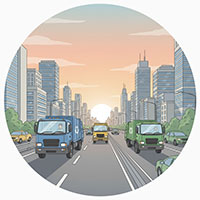
For this assignment, you’ll spend some time learning about the waste infrastructure in your local community, town or city. For this task, you should attempt to discover how your area manages and treats its solid waste.
You can also expand your investigation to find out what kinds of second hand or salvage facilities exist in your area, as well as what kinds of infrastructure is used to treat wastewater and so on. However, the core of this assignment is to become familiar with the often invisible waste management infrastructure upon which you depend.
To complete this assignment, you’ll need to decide how to delineate your area. Because this is an assignment about knowing your infrastructure, it should be bigger than your household or street, but smaller than a country. You might choose a province, state, city, town, or county to examine. Depending on how populous your area is, you might need to narrow down your search or expand it as you go.
Share your findings and reflections at the Studium course area that opens October 1, 2025, or in the Whatsapp group (get link on Studium or send sms for invite to +46730650228).
Step 1: Questions for mapping local waste infrastructure
As you try to understand the waste infrastructure around you, ask yourself some or all of the following questions:
- What companies pick up your solid waste? Are those companies private, and do you contract with them yourself, or does your city or province have a contract? Are those companies local, national, or even global?
- Do you know who works at transfer stations, landfills, or for waste companies?
- Can you find out from government or municipal websites (or industry websites if your waste haulers are privately owned) where household waste is taken?
- Does your area have transfer stations or landfills currently operating? If so, do they take waste from other areas?
- Does your area have sealed or closed landfills or transfer stations? When were they decommissioned?
Step 2: Recyclables and compost
Repeat this process for your recyclables and compost. If you live in an area that does not compost, note that, as well as whether you compost at home. If you live in an area that does not take food waste, but takes garden waste, note that and find out where it goes.
Step 3 (optional): The larger system of waste management
Can you discover how your area is attached to a larger system of waste management, or how other kinds of waste – for example, construction waste – is managed in your area? Or can you amass a list of material that is kept out of the waste stream? Are there, for example, salvage yards, thrift stores, second hand stores and similar places in your town? How do they collect material? Do you know how long they keep material before they give it away or turn it over to the waste stream?
© Daniel Mossberg, CEMUS, Uppsala University and Sonali Phadke, studio Alternatives and Stephanie Foote