
Part 1 | Part 2 | Part 3 | Part 4 | Part 5
3.2
Upcycling: Beyond Recycling and Waste

Upcycling, a value creation from waste, basically making new stuff out of things that otherwise would have ended up in the waste stream. In this step we’ll go through the concept, theory and some practical applications. Upcycling is also known as creative reuse.
Upcycling is the process of transforming waste or unwanted items into new products of greater value, and with an environmental benefit by reducing both consumption and waste. Unlike traditional recycling, which breaks materials down into raw components (downcycling), upcycling maintains the original material’s integrity while upgrading its purpose and aesthetic. It’s a critical method in the circular economy model, aiming to keep materials in circulation at their highest possible value for as long as possible.
Concept and Practical Applications
The concept of upcycling as a strategy for ecological design was significantly advanced in the 2013 book ‘The Upcycle: Beyond Sustainability – Designing for Abundance’ by William McDonough and Michael Braungart. This work refined the initial design thinking, moving beyond mere sustainability – which they term less bad – to a design framework that is actively regenerative and beneficial. The authors expand upon the core idea of ‘Cradle-to-Cradle’ design (see Part 2), where materials are perpetually cycled, thus eliminating the concept of waste.
Upcycling helps reduce reliance on virgin materials, conserves natural resources, and significantly decreases the volume of waste sent to landfills or incineration. The foundational principle of upcycling is valuing waste and shifting the mindset from a linear consumption model to circularity. This process requires creativity and often involves techniques like refitting, redesigning, stitching, patching, and darning to transform an item into a value-added product. Upcycling is a design-driven approach that injects creativity and unique value into the waste stream, and it demands less energy input than recycling since the material is not broken down and re-processed.
Upcycling spans small-scale to industrial uses, notably in fashion (transforming old textiles into new apparel) and furniture (repurposing cabinets or pallets). It also involves industrial regenerative design to keep materials in closed-loop systems. Highly dependent on creativity and craft skills, upcycling is a sustainable waste management method.
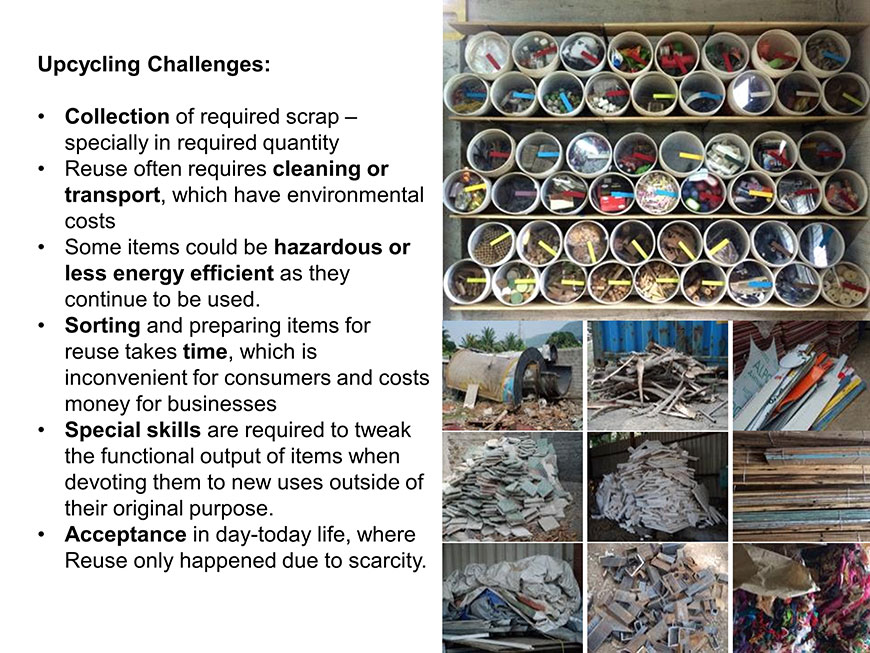
Upcycling challenges from the presentation by Sonali Phadke in step 3.7 Working with Waste: Encouraging Creative Reuse and Upcycling
Further reading, learning and references
Peterson Speaker Series – William McDonough on “The Upcycle” https://youtu.be/j2IyijbuajA
McDonough, W., and Braungart, M. (2013). The Upcycle: Beyond Sustainability – Designing for Abundance https://mcdonough.com/writings/the-upcycle/
Kempster, C. (2020). Better Than New: Tips for Upcycling and Refinishing Furniture. https://www.chloekempster.com/products/better-than-new-tips-for-upcycling-and-refinishing-furniture
Rodabaugh, K. (2022). Make, Thrift, Mend: Stitch, Patch, Darn, Plant-Dye and Love Your Wardrobe. https://www.abramsbooks.com/product/make-thrift-mend_9781419743993/
DK (2021). Recycle and Remake: Creative Projects for Eco Kids. https://www.dk.com/us/book/9780241395813-recycle-and-remake/
© Daniel Mossberg, CEMUS, Uppsala University and Sonali Phadke, studio Alternatives and Stephanie Foote