Part 1 | Part 2 | Part 3 | Part 4 | Part 5
3.12
Turning Recycled Textiles into New Fabrics: Corertex Consortium and Re-Fresh Global
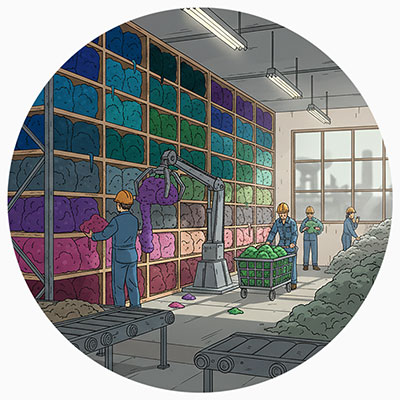
Although most textile waste ends up in landfills or are incinerated, it’s important to understand how textiles successfully can be recycled. In this step we look at two examples – Corertex Consortium and Re-Fresh Global.
Corertex is a consortium for textile reuse and recycling based in the Prato textile district, Italy, using over a century of local experience. The organization was founded by eight companies (six in reuse, two in recycling). Corertex aims to extend the life of clothing and transform used garments into new fabric, significantly reducing emissions and water consumption in the process.
Re-Fresh Global transforms all types of textile waste into new raw materials using biotechnology. Their specialized SMART-UP enzymatic technology creates products like nanocellulose (Re-Nano), bioethanol (Re-Thanol), and a customizable textile pulp (Re-SanPulp). The process uses waste to create new products or stocks, lowers the carbon footprint, and reduces resource use.
Corertex Consortium in Prato: Reuse and Recycling for a Sustainable Society
In the first video we visit Prato, Italy, which processes 15 percent of the world’s recycled clothes. They use a 100-year-old system of sorting and shredding textiles to create new, sustainable wool fibers. This process halves CO2 emissions and minimizes waste.
Re-Fresh Global: Transforming Textile Waste into New Raw Materials
In the second video we look at how Re-Fresh Global addresses the massive textile waste problem with urban micro-factories. Their tech-integrated, end-to-end process rescues up to 98 percent of discarded textiles. The waste is sorted for reuse or recycled into new fabrics, construction materials, and nanocellulose, working towards a more circular approach to textile waste.
Although these two examples present different models for implementing textile recycling, both face unique challenges. Prato’s Corertex mechanical model is strained by the high cost of labor and its struggle with fast fashion’s blended fabrics. Meanwhile, advanced enzymatic recycling (Re-Fresh Global) faces high scale-up costs relative to virgin materials. Both innovative solutions are hindered by economic barriers and complex EU regulations.
Further reading, learning and references
Corertex Consortium Prato – Recycling https://corertex.it/en/recycling/
Re-Fresh Global https://re-fresh.global/
Fashion for Good – The State Of Textile Waste In India https://reports.fashionforgood.com/report/sorting-for-circularity-india-wealth-in-waste/chapterdetail?reportid=813&chapter=3
European Commission – EU strategy for sustainable and circular textiles https://environment.ec.europa.eu/strategy/textiles-strategy_en
© Daniel Mossberg, CEMUS, Uppsala University and Sonali Phadke, studio Alternatives and Stephanie Foote