
Part 1 | Part 2 | Part 3 | Part 4 | Part 5
4.5
Mushroom Computing: The Wood Wide Web and Fungi Tech Applications
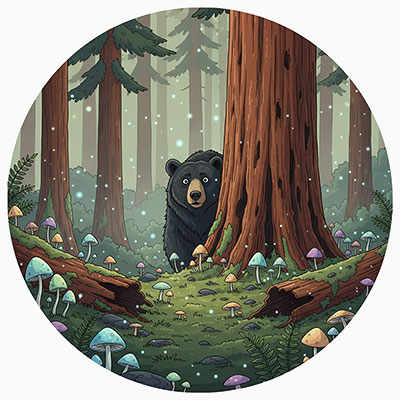
In this step we’ll take a closer look at research on fungal computing and how the theory of the Wood Wide Web has inspired new mushroom tech applications.
The Wood Wide Web is the popularized name for a Common Mycorrhizal Network. This vast mycelial network, made of fungal threads, connects the root systems of trees and other plants underground. It acts as a resource highway, facilitating the two-way transfer of vital resources like carbon, water, and nutrients (for example, nitrogen and phosphorus), and enables chemical defense signaling between connected species.
Fungal computing uses the Wood Wide Web’s natural mycelial networks, which act like biological neural networks. Researchers utilize the electrical signaling within these fungal structures – similar to signals in a brain – to develop highly parallel and adaptable wetware that can solve complex computational problems beyond the capabilities of current binary computers.
The following video explores fungal computing, a field where scientists, such as those at the Unconventional Computing Laboratory in Bristol, are harnessing the information-processing power of fungi. Mycelial networks, like the ‘Wood Wide Web’, transmit electrical signals, which can be translated into binary data. These ‘wetware’ systems could perform parallel calculations faster than traditional computers, leading to advancements in AI and biodegradable electronics.
Further reading, learning and references
University of Bristol – Unconventional Computing Laboratory https://uncomp.uwe.ac.uk/
European Wilderness Society – The Wood Wide Web https://wilderness-society.org/the-wood-wide-web-supports-wild-forests/
Simard, S. W., Beiler, K. J., Bingham, M. A., Deslippe, J. R., Philip, L. J. and Teste, F. P. (2012). Mycorrhizal networks: Mechanisms, ecology and modelling. Fungal Biology Reviews Volume 26, Issue 1 https://doi.org/10.1016/j.fbr.2012.01.001
Diverse Intelligences Summer Institute – Rethinking the “wood wide web” https://disi.org/rethinking-the-wood-wide-web/
© Daniel Mossberg, CEMUS, Uppsala University and Sonali Phadke, studio Alternatives and Stephanie Foote