Part 1 | Part 2 | Part 3 | Part 4 | Part 5
5.7
Community, Culture and Art: Creative Circularity and Upcycling Festivals
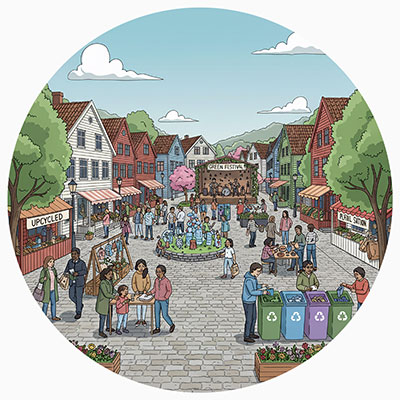
This step explores the social and cultural dimensions of circularity, looking at how grassroots movements, artistic expression, and community-led events can transform circularity from a technical requirement into a desirable lifestyle and shared experience.
While legislation and finance provide a structural framework for change, culture can offer the soul and energy needed to sustain it. A circular society has the potential to flourish when it is rooted in community and expressed through creative mediums that invite us to rethink our relationship with society, throwaway culture and ourselves.
Art as a Catalyst for Change
Artists make abstract resource concepts tangible and emotionally resonant, shifting how we perceive value. Here are three examples:
- Transforming Perception: Nigerian sculptor Gbenga Adeku turns plastic waste into stunning masterpieces, proving that creativity can elevate discarded materials into high-value art.
- Confronting Consumption: In The Last Straw, Bryant Holsenbeck documents her quest to live without disposable plastic, using massive installations of bottle caps and straws to force a dialogue on environmental urgency. More on Holsenbeck’s work in the video below.
- The Emotional Life of Objects: The Museum of Broken Relationships highlights the narratives attached to material items. By focusing on the memories held within objects, it encourages a culture of preservation and emotional connection over mindless disposal.
Community Celebrations: Upcycling Festivals
Public events serve as cultural laboratories, moving circularity from a technical requirement to a celebratory lifestyle.
- Local Engagement: Sweden’s Återbruksfestivalen (Upplands Väsby) democratizes circular skills through workshops and markets, making repair and reuse accessible and social.
- Global Innovation: The International Upcycling Festival (2024) bridges the gap between professional design and public participation, showcasing upcycling as a powerful economic and artistic force.
A circular society transforms us from passive consumers into active participants. By engaging in creative circularity, communities develop circular literacy – the ability to see potential in the discarded – while ensuring the green transition remains inclusive, diverse, and community-driven.
Further reading, learning and references
Art Africa – From Waste to Art: How Upcycle Artist Gbenga Adeku is Transforming Plastic Waste Into Stunning Art Masterpieces https://art.africa/art-africa-curatorial-space/news/from-waste-to-art-how-nigerian-sculptor-gbenga-adeku-is-transforming-plastic-waste-into-powerful-environmental-statements/
Holsenbeck, B. (2018). The Last Straw: A Continuing Quest for Life without Disposable Plastic. Durham: Resource Center For Women And Ministry In The South https://bryantholsenbeck.com/my-work-living-without-plastic/
Museum of Broken Relationships https://brokenships.com/
Återbruksfestivalen (The Reuse/Upcycling Festival) in Upplands Väsby https://www.upplandsvasby.se/bygga-bo-och-miljo/avfall-och-atervinning/aterbruksfestivalen
International Upcycling Festival 2024 https://upcyclingfestival2024.our.dmu.ac.uk/
© Daniel Mossberg, CEMUS, Uppsala University and Sonali Phadke, studio Alternatives and Stephanie Foote