Part 1 | Part 2 | Part 3 | Part 4 | Part 5
5.8
Universities and Schools as Drivers for Change and Circularity
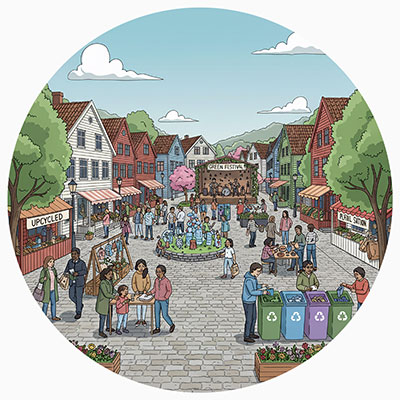
In this step we explore how educational institutions can act as catalysts for a circular transitions. By bridging research, policy, and community action, universities and schools are uniquely positioned to model the practical realities of a circular and sustainable society.
Educational institutions are often viewed simply as places for knowledge transfer. However, in the context of a circular transition, they act as powerful instruments for societal change. Universities, in particular, occupy a unique position where research, policy, and community action intersect, allowing them to model the future of a circular society.
Universities drive circularity by moving beyond just teaching about sustainability to actively creating learning communities working for it. This shifts education from a neutral academic exercise into a strategic instrument for societal change.
In the video below Katrien Van Poeck discusses how micro-learning processes, facilitated through inquiry and habit transformation, provide essential empirical foundations for achieving macro-level sustainability transitions.
Universities as Transformation Leaders
Maxim Deleye (2024) suggests that for universities to lead this transition, sustainability must move from the periphery to the core of their identity through three levels of action:
- Formal Curriculum: Integrating circular thinking into every discipline – from economics to engineering – so students enter the workforce ready to redesign linear systems.
- Institutional Practice: Modeling circularity on campus through zero-waste dining and circular procurement. These actions serve as a hidden curriculum, proving that circular systems work in practice.
- The Living Lab: Using the campus as a protected space to test circular innovations – like repair systems or circular building – in partnership with local industry before scaling them to society.
By aligning research, teaching, and operations, universities function as both the laboratory and the roadmap for a regenerative future.
Schools as Grassroots Accelerators
While universities lead through education and research, schools and primary education play a vital role in shifting cultural norms and practices. By introducing and working with concepts like upcycling, creative reuse and resource literacy at a young age, schools play a crucial role in reshaping society. They act as community hubs where parents, teachers, and students collaborate on local sustainability projects, fostering a sense of collective agency.
From Knowledge to Action
The transition to a circular society requires more than just technical data, it requires a shift in values and social structures. Universities and schools are the primary sites where these new values are negotiated. When these institutions embrace their role as drivers for change, they do more than produce work-ready graduates – they produce world-ready citizens capable of navigating and leading the transition to a regenerative future.
Further reading, learning and references
SEAS blog – Education as an instrument for societal change or as an end in itself? https://www.seas.uio.no/blog/2021/education-as-an-instrument-for-societal-change.html
Deleye, M. (2024). The Sustainable University: An exploration of how the sustainable university is conceptualized and takes shape. PhD dissertation, Acta Universitatis Upsaliensis https://urn.kb.se/resolve?urn=urn:nbn:se:uu:diva-525867
Hald, M. (ed.) (2011). Transcending Boundaries: How CEMUS is Changing How We Teach, Meet and Learn. Uppsala: Centrum för miljö- och utvecklingsstudier i Uppsala (CEMUS) https://www.cemus.uu.se/transcending-boundaries/
Bacal Roij, A. (ed.) (2022). Transformative Research and Higher Education. Emerald Publishing https://www.emerald.com/books/edited-volume/12679/Transformative-Research-and-Higher-Education
Barrineau, S., Engström, A. and Schnaas, U. (2019). An Active Student Participation Companion. Uppsala: Academic Teaching and Learning, Uppsala University https://uu.diva-portal.org/smash/record.jsf?pid=diva2%3A1286438&dswid=-5327
van Boeckel, J. (2014). At the Heart of Art and Earth: An Exploration of Practices in Arts-Based Environmental Education. Aalto University https://janvanboeckel.com/at-the-heart-of-art-and-earth/
© Daniel Mossberg, CEMUS, Uppsala University and Sonali Phadke, studio Alternatives and Stephanie Foote