
Part 1 | Part 2 | Part 3 | Part 4 | Part 5
3.17
Urban Mining and Recycling of E-waste
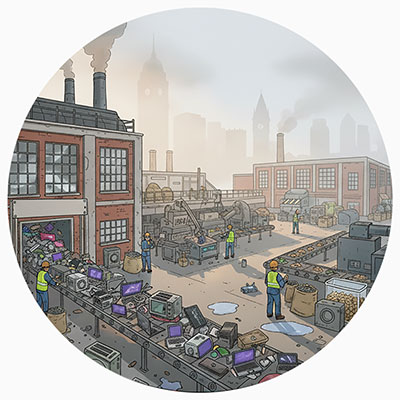
In this step we’ll return to the issue of e-waste and how metals in electronic gadgets can be recycled. We’ll also look at global metal use, recycling and the concept of Urban Mining.
Global metal use, essential for construction and manufacturing, is dominated by iron ore mining (2.4-2.6 billion tonnes annually) for steel production (1.892 billion tonnes). Aluminum (69 million tonnes) is the second most-used metal. Demand for low-volume technology metals (like lithium) and rare-earth metals is rapidly increasing due to the energy transition.
Global metal waste is offset by high recycling rates for materials like steel, with over 650 million tonnes of steel scrap recycled annually. However, e-waste is a growing concern, generating a record 62 million tonnes in 2022, but only 22.3 percent was collected, losing critical, high-value metals. Additionally, metal production creates 400 million tonnes of toxic metallurgical waste yearly.
Urban Mining in Anthropogenic Mines
Urban mining is the systematic process of reclaiming valuable raw materials, such as critical metals and aggregates, from the built environment (buildings, infrastructure, and e-waste flows). This approach treats cities as ‘anthropogenic mines’ to reduce reliance on virgin resource extraction, create conditions for a circular economy, and mitigate environmental impacts. In the video below you get an introduction to urban mining in an EU-context.
Recycling E-waste
The second video goes through how to dispose of e-waste by selling, donating, and using formal recycling centers, showing how complex and costly material recovery is at a large-scale facility. Planned obsolescence is the design of products to have an artificially limited lifespan, shortening product life cycles and accelerating the growth of global e-waste.
The short video here covers a similar issue concerning e-waste.
Further reading, learning and references
McKinsey & Company – Global Materials Perspective 2025 https://www.mckinsey.com/industries/energy-and-materials/our-insights/global-materials-perspective
International Energy Agency – The Role of Critical Minerals in Clean Energy Transitions https://www.iea.org/reports/the-role-of-critical-minerals-in-clean-energy-transitions/executive-summary
United Nations Institute for Training and Research – The global E-waste Monitor 2024 – Electronic Waste Rising Five Times Faster than Documented E-waste Recycling https://ewastemonitor.info/the-global-e-waste-monitor-2024/
Fraunhofer ISI – The promise and limits of Urban Mining https://publica.fraunhofer.de/bitstreams/31ba6c53-5eb1-4b96-b7d8-247e67a923b9/download
Vijay Kumar, V. (2025). Reclaiming Resources from WEEE: A Socio-Technical Case Study of Municipal EPR Implementation and Urban Mining in Uppsala. Uppsala University https://urn.kb.se/resolve?urn=urn:nbn:se:uu:diva-565855
European Parliament – Planned obsolescence: Exploring the issue https://www.europarl.europa.eu/RegData/etudes/BRIE/2016/581999/EPRS_BRI(2016)581999_EN.pdf
BBC News – E-waste ‘drawers of doom’ growing, say campaigners https://youtu.be/gAAWVfcnk3A
© Daniel Mossberg, CEMUS, Uppsala University and Sonali Phadke, studio Alternatives and Stephanie Foote