
Part 1 | Part 2 | Part 3 | Part 4 | Part 5
4.19
Permeable Pavement and Porous Asphalt: Extreme Weather and Climate Adaptation
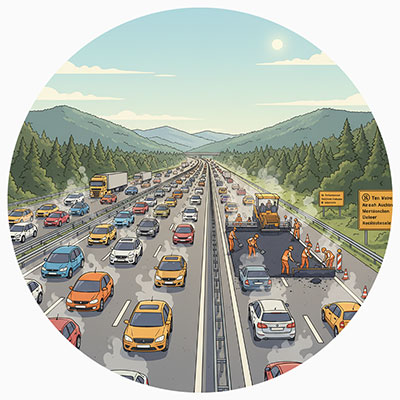
In this final step on earth construction we’ll highlight two applications of not so sustainable materials used to adapt to extreme weather events like flooding and heat waves.
Permeable pavements are key Low Impact Development (LID) and Sustainable Drainage Systems (SuDS) engineering strategies that mimic natural hydrology to manage, slow, store, and treat urban stormwater runoff. They reduce flooding and recharge groundwater while filtering pollutants and cooling the city. However, they are unsuitable for heavy traffic or steep slopes, requiring regular maintenance to prevent clogging and limit effectiveness in cold or clay-heavy soils.
The video below explains how permeable pavement works to manage urban stormwater runoff by allowing rain to infiltrate the ground and recharge groundwater.
Porous asphalt as detailed by Singh and Varveri (2024) has several advantages:
- 90 percent of the Dutch highway network uses porous asphalt, primarily for its noise reduction and enhanced skid resistance in wet conditions.
- Porous asphalt reduces tire-pavement noise by up to 6 decibels compared to conventional asphalt, and this noise-reduction benefit persists even when partial clogging occurs.
- Applying life-extension maintenance (like rejuvenation) can add 2 to 6 years per cycle, improving porous asphalt’s cost-benefit ratio and extending the structure’s overall sustainability.
- Porous asphalt has a higher void content (15-20 percent) versus conventional asphalt (3-6 percent), increasing water permeability 6 to 10 times and reducing the risk of aquaplaning.
Further reading, learning and references
C40 Knowledge Hub – Flooding: How to increase your city’s permeability https://www.c40knowledgehub.org/s/article/Flooding-How-to-increase-your-city-s-permeability
EPA – Soak Up the Rain: Permeable Pavement https://www.epa.gov/soakuptherain/soak-rain-permeable-pavement
Singh, A. and Varveri, A. (2024). Quantification of lifecycle costs for porous asphalt life-extension maintenance methods under managerial uncertainties. International Journal of Pavement Engineering, 25(1) https://doi.org/10.1080/10298436.2024.2376221
Global Center on Adaptation – Could this new type of concrete help cool our overheated cities? https://gca.org/could-this-new-type-of-concrete-help-cool-our-overheated-cities/
© Daniel Mossberg, CEMUS, Uppsala University and Sonali Phadke, studio Alternatives and Stephanie Foote