Part 1 | Part 2 | Part 3 | Part 4 | Part 5
4.2
Organic Cotton: Farmers, Soils, and Water Resources
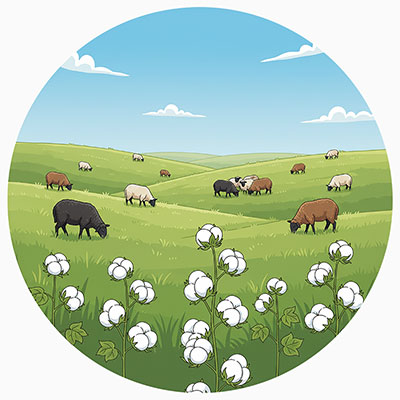
In this step, we’ll take a closer look at the production of organic cotton and its potential for market expansion. We’ll examine the current annual production volume, the benefits for farmers, local communities, and soil health, and how organic cotton production drastically reduces the need for water.
The Materials Market Report 2025 lists several important key takeaways for textiles:
- Global Production Surges: Total fiber production reached 132 million tonnes in 2024 (doubling since 2000) and is projected to hit 169 million tonnes by 2030.
- Fossil-Based Synthetics Drive Growth: Polyester is the most produced fiber (59 percent of total); 88 percent of it is fossil-based, with its volume growing significantly in 2024.
- Recycled Polyester: Volume increased to 9.3 million tonnes, but its market share slightly fell (12.5 percent to 12 percent) due to the faster surge in virgin material production.
- Cotton’s Market Share Falls: Cotton remains the second most produced fiber, but its global market share fell by 1 percent to 19 percent (volume 24.5 million tonnes).
- Recycled Fibers Stable: The total recycled fiber market share stabilized at 7.6 percent (mostly recycled polyester), with less than 1 percent sourced from used pre- or post-consumer textiles.
- Certification Increases: Fibers from certified sources are rising: 34 percent of cotton, two-thirds of manmade cellulosic fibers, and half of all mohair are now certified.
Organic cotton represents only about 1.4 percent of the total global cotton crop, around 0.3 percent of produced fibers annually. The 34 percent certified figure listed above includes all types of cotton certification that have shared data with the Material Market Report, including organic cotton.
In the video below the environmental and social impacts of conventional cotton production, which uses vast amounts of water and harmful chemicals, are detailed. Organic cotton is a sustainable alternative that uses 91 percent less water, protects soil health, bans genetically modified seeds, and supports farmers.
Scaling Up Organic Cotton Production
For this topic we’ve created a bonus episode of the course companion AI-podcast in Google NotebookLM. We’ve selected the sources and did the quality check, with NotebookLM putting together the actual conversation with AI voices. You can also listen on YouTube here.
Further reading, learning and references
Textile Exchange – Materials Market Report 2025 https://textileexchange.org/knowledge-center/reports/materials-market-report-2025/
WWF – Enhance the impact of sustainability standards on smallholder cotton farmers in Maharashtra https://ikea.wwf.se/projects/enhance-the-impact-of-sustainability-standards-on-smallholder-cotton-farmers-in-maharashtra/
OCA – Organic Cotton Accelerator annual report 2024 https://annual-report-2024.organiccottonaccelerator.org/
Innovation Forum – The future of cotton farming: scaling regenerative sourcing https://youtu.be/Lv-HrIMlRTM
© Daniel Mossberg, CEMUS, Uppsala University and Sonali Phadke, studio Alternatives and Stephanie Foote