Part 1 | Part 2 | Part 3 | Part 4 | Part 5
1.1
Welcome to the Course and Part 1
It’s time to start the Circular Economy: Material Flows and Sustainable Materials – Practical Applications open online course and Part 1! All three of us course creators – Stephanie Foote, Daniel Mossberg and Sonali Phadke – want to welcome you on an educational journey where we together will explore how circularity can be implemented and practiced in different fields.
This first page is quite long, but coming steps in the course are not as text-heavy.
Invite your friends and colleagues
There is still time to invite friends and colleagues to join the course and take part alongside you. Having the support of people you know can really enrich the experience of studying online. They can enroll directly here here or you can share the link to the course start page www.cemus.uu.se/cirec for more information.
Part 1: Introduction to the Circular Economy
During the first, two-week part of the course we will get an overview of the shortcomings of the current economic system, introduce the concept and principles of the circular economy, take a closer, critical look at the blind spots of the circular economy framework, introduce the work of studio Alternatives, CEMUS and Uppsala University. After that you will start the work on your weekly assignment. The second week focuses on waste flows, history of waste, global and local examples, and you get to start your own circularity portfolio work. Finally, the week and part 1 wraps up with your weekly assignment.
Course structure and what you will learn during the course
The course is structured into five parts with each part being two weeks. Since the course is self-paced you don’t need to stress about completing each part within two weeks. These are the five parts we will go through:
- Part 1: Introduction to the Circular Economy
Part 2: Design for Recycling
Part 3: Use of Recycled Materials
Part 4: Substitution with Sustainable Alternatives
Part 5: Conditions for Circular Systems and Economies
We have set three main learning goals, detailing what you will learn during the course, these are:
- How circular economy, material flows and sustainable materials can be understood in a broader sustainability context.
- Using various tools and models to analyze and improve material flows and product design.
- Practically apply and implement the knowledge in the course to their own business or a chosen project.
See course start page for course description and further details here.
How it works – a self-paced open online course
The course is intended to be studied over ten weeks with around eight hours of weekly study time. It is organised in steps (pages) where you can set your own pace and divide up the time you spend studying per day. A lot of the material in the course can be listened to while taking a walk, cooking or traveling, and to make it easier to listen to while doing other things we have set up the Going Circular with CEMUS and studio Alternatives podcast and a YouTube playlist here. The podcast episodes and playlist videos follow the course from the beginning to the end.
When you feel that you are done with a step just click the Next »-button, you can always go back to a previous step and jump between different weeks if you need to go back and pick up a reference, idea or quote. To keep track of your own progress it is recommended to get a digital or paper notebook where you can take notes, write down ideas and mark a step as complete when you are done.
We will release the different coming parts of the course along the way – Part 2 will be released October 15, Part 3 on October 29, Part 4 on November 12, and finally Part 5 on November 26.
No credits are awarded for this course, but you will receive plenty of knowledge and practical ways of working with the issues, and after the completion of the course you will be awarded a certificate.
Take part in CEMUS events and follow studio Alternatives work
At CEMUS web page www.cemus.uu.se you can get the latest news and posts on all open events organised in Uppsala and online. You can also sign up to CEMUS monthly newsletter for an easy way to keep track of all the things happening at CEMUS, and we are continuously posting on different social media platforms. To follow studio Alternatives work go to their web page www.studioalternatives.com where you also have links to their social media.
The Circular Economy and its Practical Applications – A Conversation on Learning and Circularity
Connecting with course creators, discussion forums and ways of communicating
You can connect with other learners through the comments section through the course run on Uppsala University’s studium page that opens October 1, 2025, or in the Whatsapp group (get link on Studium or send sms for invite to +46730650228).
Once again, warmly welcome to the Circular Economy: Material Flows and Sustainable Materials – Practical Applications course!
Contact and lead educators
Please contact Daniel Mossberg, daniel.mossberg@cemus.uu.se, with your questions.
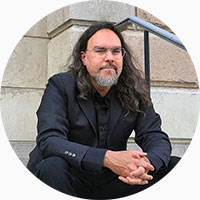 Daniel Mossberg Lead Outreach and Educational Coordinator CEMUS, Uppsala University
Daniel works as lead outreach coordinator and educational coordinator at CEMUS with a wide range of first-hand experience of student-led education, developing new, interdisciplinary courses and programs, open events in collaboration with different partners, creative projects with a focus on local sustainability, critical conversations on current and existential issues, open online courses on climate change leadership and much more. He has worked as course coordinator, director of studies, deputy director, with an academic background in cultural anthropology, philosophy, American studies, environment and development studies and climate and sustainability studies. Engaged as student, staff and union representative over the years, and now safety representative at CEMUS.
daniel.mossberg@cemus.uu.se
073-065 02 28
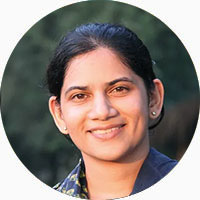 Sonali Phadke Partner and Creative connections studio Alternatives
Sonali comes with an engineering background, and her family business in composites and plastics triggered her initial interest in reusing waste. Also, an alumna of The Ecological Society Pune has been a resource person for many environment/socio-economic projects and surveys. She has been an active member of Oikos for Ecological Services and was a part of the Maharashtra Environment Department-funded project on Eco-Education. She is also a team member of the Grassland Trust that works in grassland conservation from both the aspects of human and wildlife concerns. With her background, Sonali brings in the aspect of sustainability from the ecological perspective in the studio’s work.
© Daniel Mossberg, CEMUS, Uppsala University, Sonali Phadke, studio Alternatives and Stephanie Foote